Origins · stage 01
The first server
Tim Berners-Lee wrote it on a NeXT cube at CERN, and the protocol it spoke is recognisably the one still in use.
Stage 01 of six/Origins, piece 1 of 3/Long piece/Next: The standards split
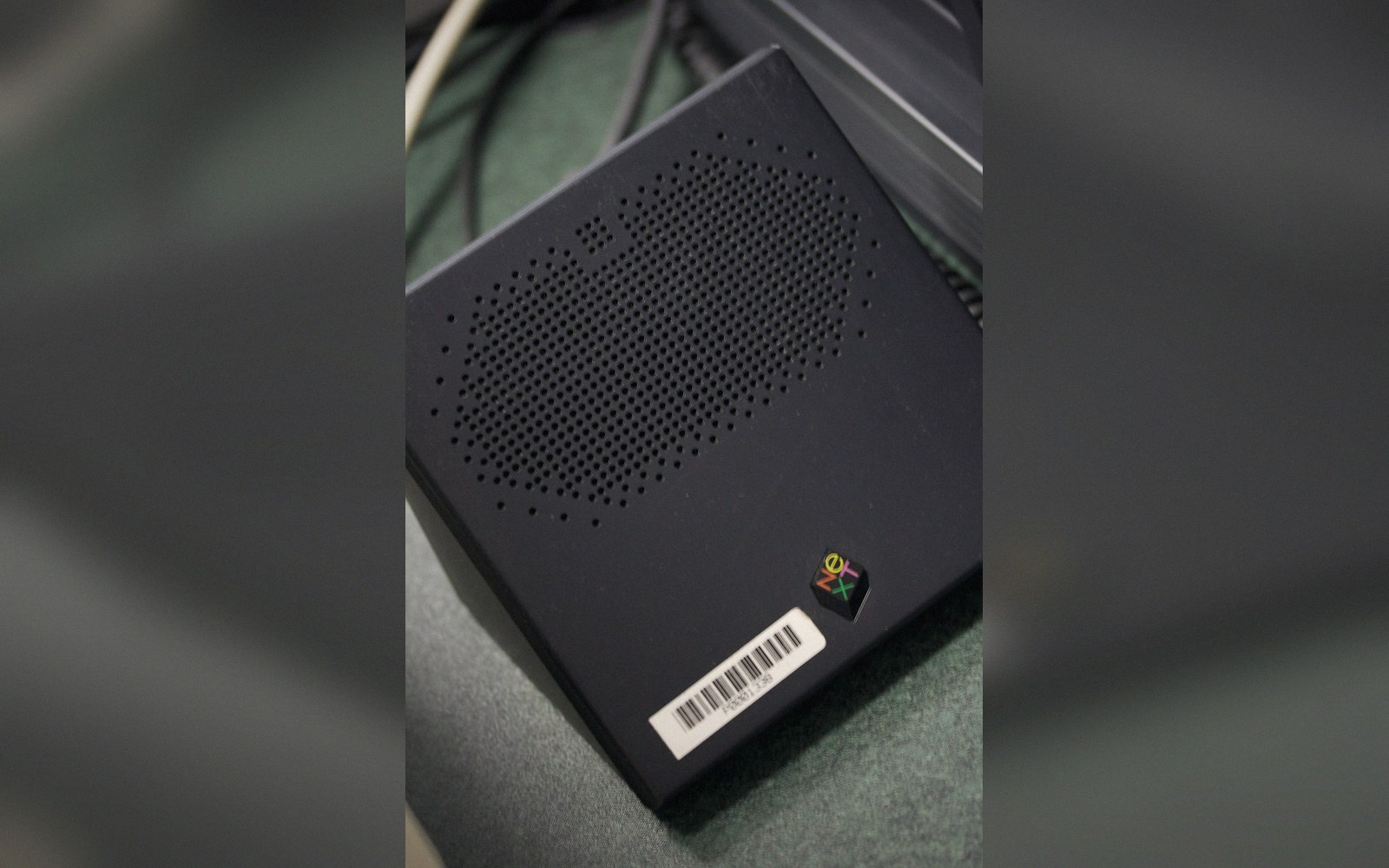
A cube in Geneva, and the protocol it still speaks
The machine was a NeXT Computer workstation — a dense black cube that Steve Jobs's company made after he left Apple — and Tim Berners-Lee kept it running at CERN's offices in Meyrin, on the outskirts of Geneva. Taped to it was a handwritten note: This machine is a server. Do not power it down. The note was necessary because the cube sat in a room full of physicists who might reasonably unplug something that looked expensive and idle. What it was actually doing, from late 1990 onward, was answering the world's first HTTP requests.
Berners-Lee had proposed something he called a distributed hypertext system in a memo to his supervisor Mike Sendall in March 1989. Sendall's marginal comment — "vague but exciting" — has since become the most quoted reaction in the history of the web. The memo was a response to a practical problem: CERN employed thousands of researchers who arrived, worked for a stretch, left, and took their knowledge with them. Berners-Lee wanted a system that would let information outlive the individuals who created it, survive institutional reorganisation, and remain navigable without any central administrator who had to approve each link. What he described would become, almost exactly as sketched, the World Wide Web.
The software he wrote on the NeXT was both a server and a browser — the only browser initially, since no one else had one yet. He named the server httpd, meaning HTTP daemon, following Unix convention. A daemon is a background process that waits and responds; the name has stuck across every generation of server software since. Robert Cailliau, who co-authored a later revised proposal with Berners-Lee in 1990, helped push the project forward inside CERN, arguing internally for resources and recognition. The two of them were, for a period, essentially the entire web.
Chronology
In order- March 1989Berners-Lee submits original hypertext proposal to CERN supervisor Mike Sendall
- Late 1990First HTTP server operational on NeXT cube at CERN, Meyrin (Geneva)
- November 1990Revised proposal co-authored with Robert Cailliau
- Summer 1991Web opened to the broader internet, starting with physics research sites
- 1994W3C founded; Håkon Wium Lie proposes CSS
- 1996RFC 1945 formalises HTTP/1.0 with headers and status codes
- 1997Apple acquires NeXT, inheriting its OS lineage
What the protocol actually said
HTTP, as Berners-Lee first specified it, was almost absurdly simple. A client opened a TCP connection, sent a single line — a method, a path, and nothing else — and the server responded with a document and closed the connection. The version retroactively labelled HTTP/0.9 had exactly one method: GET. There were no headers, no status codes, no content-type declarations. If the resource existed, you got its bytes. If it did not, you got nothing, or an HTML error document that the client could not distinguish from a successful response by any mechanical means.
This matters not because the simplicity was a design virtue, but because the mechanism — a request consisting of a method and a path sent over TCP, followed by a response — is structurally identical to what HTTP/1.1, HTTP/2 and HTTP/3 still do, despite thirty years of additions. The multiplexing in HTTP/2, the UDP transport in HTTP/3, the header compression in both: these are optimisations layered on a model in which a client names what it wants, and a server delivers it or says why it cannot. Berners-Lee's single-line GET established that model, and the W3C and the IETF, which later took over different pieces of the specification, have worked within it ever since.
HTTP/1.0, formalised in RFC 1945 in 1996, added the request headers and status codes that any working web developer knows — 200 OK, 404 Not Found, Content-Type. HTTP/1.1, in RFC 2068 and then RFC 2616, made persistent connections the default, allowing multiple requests down a single TCP connection and removing the open-close-open overhead that had started to hurt as pages accumulated images and stylesheets. Each version added without removing, because nothing on the web is ever removed: servers that speak only 0.9 still exist in archival contexts, and compliant clients are expected to handle them.
What the NeXT had that mattered
The choice of NeXT hardware was, in a narrow technical sense, incidental — Berners-Lee used what CERN had acquired. But the NeXT ran a Unix-derived operating system with a sophisticated object-oriented development environment, and that environment made it fast to build networked software. NeXTSTEP's display PostScript, its Interface Builder and its Objective-C frameworks are part of why the first browser-editor was sophisticated enough to demonstrate the concept credibly. The same lineage, via Apple's acquisition of NeXT in 1997, runs through macOS and iOS today.
The server's first content was CERN's own telephone directory and organisational documentation — prosaic material, but exactly right for demonstrating that hypertext links could replace the awkward index-and-cross-reference structures that paper documents required. When Berners-Lee made the service available outside CERN in the summer of 1991, first to high-energy physics sites and then to the internet at large, the content was still modest: documentation, pointers to FTP archives, the original proposal documents. Traffic was light enough that a single NeXT cube could handle it without difficulty.
The server's address was info.cern.ch, and CERN has preserved a reconstruction of the original site at that URL. The DNS record resolves; the pages load. What you get is a window into a web before images were part of the format, before CSS existed in any form, before Håkon Wium Lie proposed style sheets in 1994 — a set of text documents connected by links, which is, stripped of everything added since, still the thing. You can read Berners-Lee's original 1989 proposal, preserved by the W3C, in a browser that would be unrecognisable to him and yet is executing the same GET-over-TCP exchange his daemon handled on the cube.
The same lineage, via Apple's acquisition of NeXT in 1997, runs through macOS and iOS today.
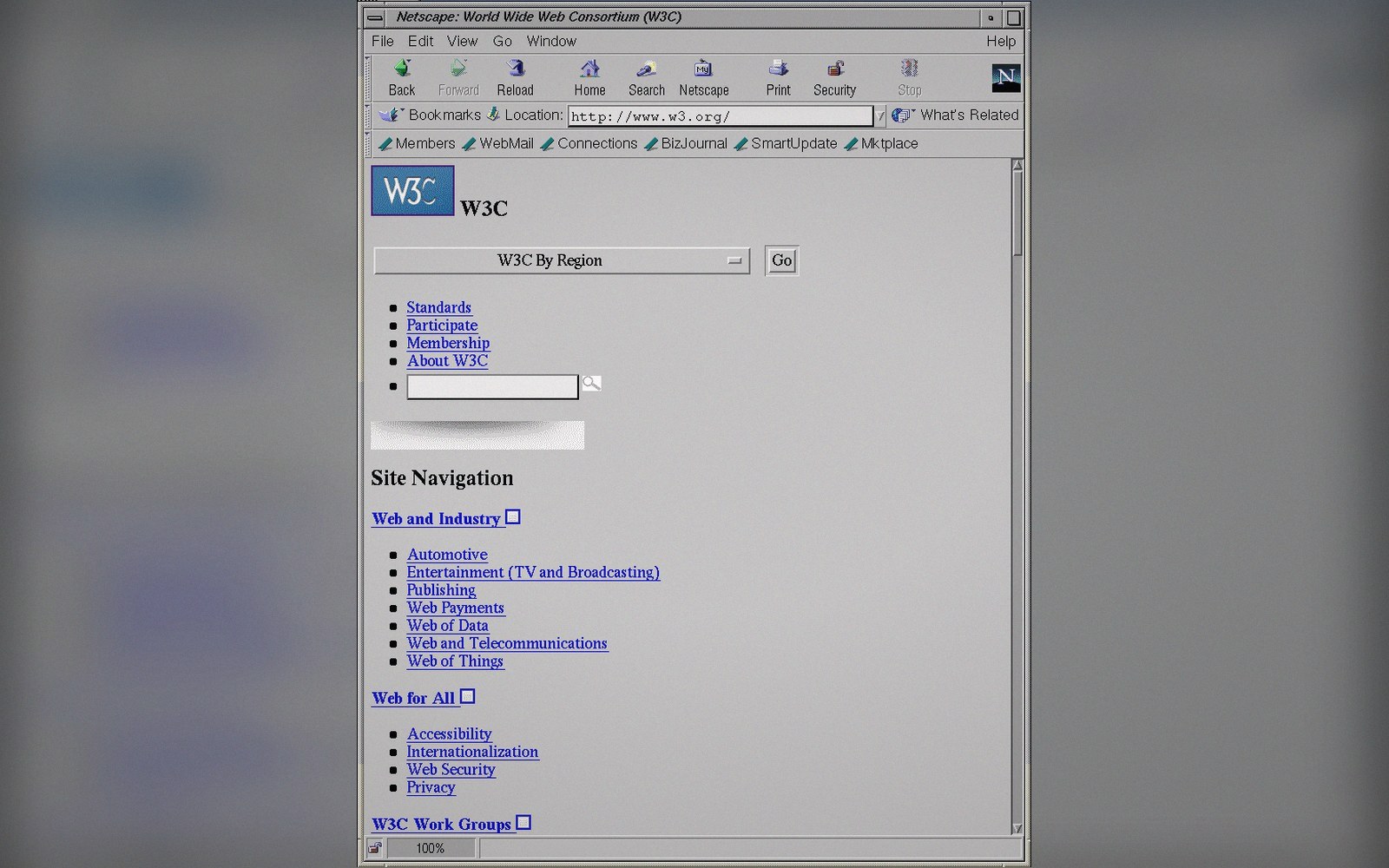
The W3C itself was founded in 1994, headquartered jointly at MIT in Cambridge, Massachusetts and at CERN, later moving its European base to INRIA in France. Its founding was partly an acknowledgement that the web had grown beyond what one institution and one engineer could govern. Within a year of its founding, there were tens of thousands of web servers. The protocol that had lived on a single black cube became infrastructure.
What the NeXT machine represents is not a curiosity or a milestone plaque moment — it is the point at which a request-response model was committed to, and that commitment has proven durable in a way that almost no other early internet decision has. The names of the methods, the structure of the URL, the separation of header from body: all of it was sketched in that first implementation, in a room in Geneva, on hardware that no one was allowed to switch off.